A new recording of Geoffrey Gordon's works on the Neuma Records label ....
27 April 2026
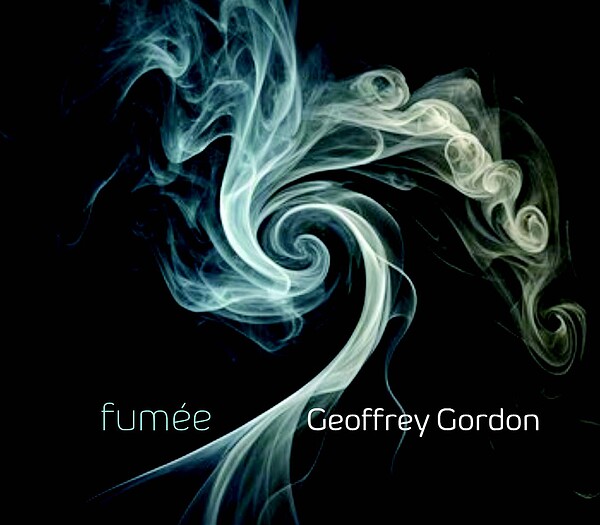
Smoke, sometimes, gets in your ears. Neuma Records announces the release of Fumée, featuring world premiere recordings of three major orchestral works by British-American composer Geoffrey Gordon. Each composition transforms visual art into music: Willem de Kooning’s explosive Abstract Expressionism, a haunting Belle Époque chanson, and the early-20th-century Synchromist movement’s “color orchestration” all find new life through Gordon’s vividly imagined scores.
The album opens with Gotham News (2018), Gordon’s response to de Kooning’s staggering 1955 painting of the same name. “If it could talk, the work would yell,” a critic wrote of the canvas—a description that immediately hooked the composer, who spent part of his youth in New York. Housed in Buffalo, the painting’s “controlled chaos” of newspaper transfers and jarring colors becomes music that “explodes with the same motor-rhythmic force of de Kooning’s brushstrokes.” The Radom Chamber Orchestra under conductor Szymon Morus performs this Mario Merz Prize commission, recorded at the Krzysztof Penderecki Concert Hall in Poland.
The title work, Fumée (2022), arose from a phone call with clarinetist Davide Bandieri proposing a chamber concerto to partner with Claude Debussy’s Premiere Rhapsodie (1910). Gordon found his entry point not through Debussy directly, but through a contemporary: Reynaldo Hahn’s exquisite 1896 chanson “Fumée” (“Smoke”). The song’s melodic material and text—”Companion of the ether, indolent smoke, I resemble you somewhat”—provide all the source materials for the new concerto. Clarinetist Horácio Ferreira, praised as a “sound wizard” by Rheinische Post, joins the Hong Kong Sinfonietta under conductor Christoph Poppen. The album also includes Gordon’s idiomatic arrangement of the Debussy Premiere Rhapsodie.
Creavit Deus Hominem (2024), commissioned by Frankfurt Radio Symphony for principal oboe José Luis García Vegara, draws on Synchromism, the early-20th-century American movement pioneered by Stanton Macdonald-Wright and Morgan Russell. Synchromist painters treated color as music, with canvases pulsing in “rhythmic, almost orchestral counterpoint.” Gordon’s four-movement concerto traces a trajectory from intimacy to boundlessness, with movements titled Still Life, Cosmic, Study after Michelangelo’s Pietà, and the title movement—its Latin phrase (“And God created man”) taken from Genesis. Conducted by Duncan Ward, the Frankfurt Radio Symphony and Vegara realize music that “gathers color-worlds and refracts them into unified, energetic atmosphere.”
Geoffrey Gordon’s extensive catalog includes commissions from Radio France and Sinfonieorchester Basel, the Philharmonia, BBC Philharmonic, Munich Philharmonic, Cleveland Orchestra, and Minnesota Orchestra. Critics have hailed his work as “darkly seductive” (The New York Times), “luminous and ecstatic” (Gramophone), and “complex, richly-satisfying” (BBC Music Magazine). Fanfare’s Colin Clarke recently wrote, “Gordon’s music is incredibly impressive; it is a wonder he is not yet a household name.”